
MCP Servers You Should Know
Amit Sadaphal
June 24, 2025
1
0
100
What is MCP?
MCP stands for Model Context Protocol, an open standard (released by Anthropic in November 2024) that enables large language models (LLMs) to interact with MCP (Model Context Protocol) external tools, databases, APIs, and files in real time. It’s essentially the “USB‑C port” for AI—standardizing how neural networks connect to the outside world.
Imagine your AI assistant reaching out to Slack, Google Sheets, or your local file system without custom code for each integration. That’s MCP MCP (Model Context Protocol) in action: LLMs ask via a client, and an MCP server—built just once—handles talking to those tools through standardized resource and tool interfaces
MCP solves the “N×M” integration problem, where N different LLM hosts and M external systems previously required MCP (Model Context Protocol) custom connectors. With MCP, developers can build one connector and reuse it across all MCP hosts and models
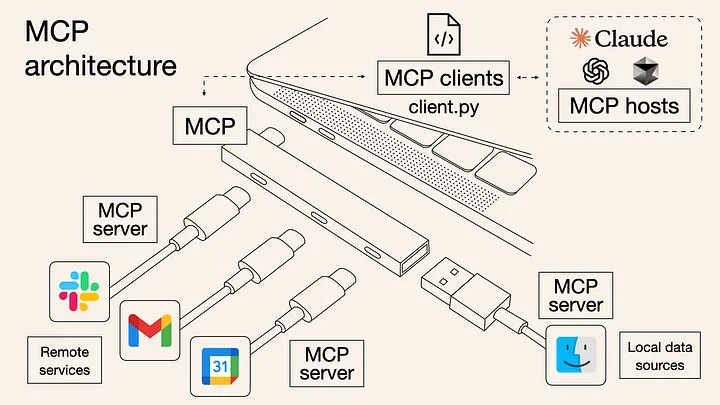
What is an MCP Server?
An MCP server is a lightweight service exposing a set of resources, tools, and prompts via the MCP interface. Resources serve data (like GET endpoints), tools execute actions (like POST), and prompts help shape queries.
For example, a ClickUp MCP server lets an LLM fetch task details and create new tasks programmatically. The server wraps the ClickUp API and registers endpoints like get_task(<id>) or create_task(...), which the LLM invokes over MCP.
MCP servers connect to both local sources (files, DBs) and remote services (Slack, GitHub). They’re discoverable via the client, scalable, and auditable. The LLM says, “Call this tool with these arguments,” and the server performs the action and returns structured responses.
1from mcp import MCPServer, resource, tool
2
3app = MCPServer()
4
5@app.resource("/hello")
6def hello():
7    return "Hello from MCP!"
8
9@app.tool()
10def add(a: int, b: int) -> int:
11    """Add two numbers."""
12    return a + b
13
14if __name__ == "__main__":
15    app.run(port=5000)
16This connects directly to your blog title “What is MCP?”, illustrating both an MCP server and how it can become part of the broader MCP ecosystem.
What is an MCP Client?
An MCP client is the component running inside the host application—like Claude Desktop, a chatbot, or an IDE—that sends calls to MCP servers and integrates the responses into the conversation.The client manages authentication, policies, and endpoint discovery.
Clients list available tools via /tools/list, then invoke them via /tools/call. Once the server responds, the client injects the results so that the LLM has real-time external context to ground its reasoning.
This setup keeps the host, client, and server decoupled: the host models speak through the client, which invokes the server, which interacts with real data sources. This enables modular design, reuse, and enterprise-grade security controls.
What are MCP Tools?
In MCP, tools are functions exposed by the server that perform actions (state changes, API calls, etc.). Clients can discover available tools and prompt the model to call them.
Tools range from simple tasks like "add(a, b)" to complex workflows like "send_slack_message(channel, text)" or "generate_invoice(customerId)". Each tool is accompanied by a schema so the LLM communicates via structured JSON.
Using tools, LLMs can not only fetch data but also trigger actions. E.g., a PayPal MCP server allows LLMs to create invoices programmatically.This expands AI capabilities from passive querying to active application orchestration.
Example: Linking a LinkedIn Post via MCP. Here’s a hypothetical example illustrating how you might auto-generate a LinkedIn post using an MCP server:
1# MCP server snippet (Python)
2@app.tool()
3def create_linkedin_post(content: str) -> str:
4    # Imagine wrapping LinkedIn’s API
5    post_id = linkedin_api.post(content)
6    return f"https://linkedin.com/posts/{post_id}"
7In your host client (e.g., Claude), you could prompt: “Draft a LinkedIn announcement about using MCP to connect AI with real‑time data sources.” The host uses the tool, and returns something like: “Your LinkedIn post has been published! This ties back to both “What is MCP?” and “MCP Server”, showing practical interaction between tools, client, and host.
Final Conclusion
With MCP, developers can plug in new systems once—and those systems work seamlessly across all AI agents. It’s truly the USB‑C of AI integrations.
Tags
About Amit Sadaphal
Ai Cloud Engineer , 16 Years experience in IT industry.
100 views
0 shares
Trending
OSSTube
NEWSLETTER
If you wanted to know more details please share email with us...