
Agent‑to‑Agent (A2A) Protocol
Raj
June 20, 2025
0
0
7
What Is the A2A Protocol?
Node.js streams are a powerful feature that allows you to process data piece by piece, rather than loading entire datasets into memory. The Agent‑to‑Agent (A2A) Protocol is an open standard developed by Google Cloud to Agent2Agent Protocol enable seamless communication among autonomous AI agents. Instead of each agent using proprietary formats or custom glue code, A2A provides a unified schema—ensuring agents can discover, negotiate, collaborate, and exchange structured messages without manual integration
At its core, A2A specifies how agents announce their capabilities via Agent Cards, follow task lifecycle definitions, and handle synchronous or Agent2Agent Protocol asynchronous messaging. Whether they’re exchanging PDFs, JSON data, or initiating long-running workflows, the A2A spec ensures agents "speak the same language".
With support from over 50 partners—like Atlassian, Salesforce, Amazon, and Microsoft—the protocol is Agent2Agent Protocol evolving as a vendor‑neutral standard, now stewarded by the Linux Foundation’s Agent2Agent Project.
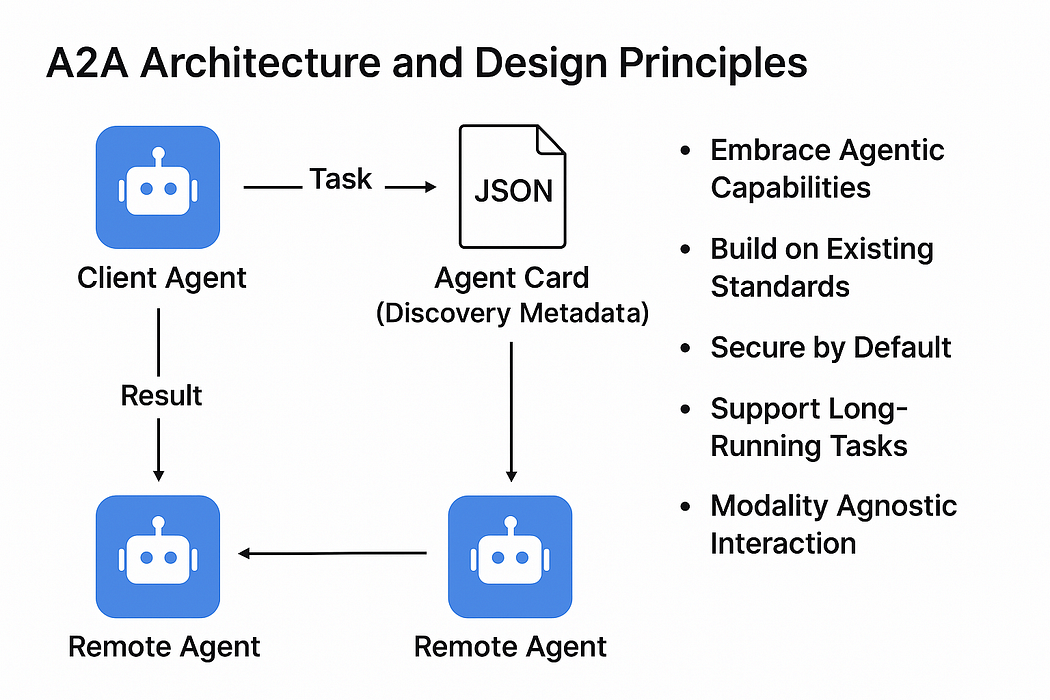
Core Principles and Architecture
A2A revolves around four foundational principles: Capability Discovery: Agents publish metadata via "Agent Cards" in JSON, outlining functions and communication endpoints. Others can discover and identify who can complete a task. Structured Task Lifecycle: Each task follows defined statuses—queued, in-progress, completed—with artifact exchange (e.g., summary text, files) wrapped in standard JSON-RPC over HTTP(S) or streaming. Secure and Modal-Aware Messaging: Built for enterprise use, A2A includes authentication standards (similar to OpenAPI), supports stateless or streaming interactions, and negotiates content modalities like forms, audio, video, or attachments.
By abstracting these details, A2A lets specialized agents (e.g., summarizer, weather fetcher, scheduler) collaborate without bespoke middleware, forming a reliable agent mesh.
Use Cases and Real-World Scenarios
A “hiring manager” agent uses A2A to request candidate profiles from a “sourcing” agent. The latter returns structured candidate info. Subsequent agents handle scheduling interviews or sending screenings.a) Candidate Sourcing Pipeline
An orchestrator UI coordinates a “strategy” agent and a “risk” agent using the Agent Development Kit (ADK) + A2A. The strategy agent proposes trades; the risk agent vets them—all via the protocol.b) Multi-Agent Trading Simulator
In enterprise, agents can handle niche tasks—like a PayPal payments agent, compliance agent, or analytics agent—communicating securely through A2A, then synthesizing deliverables.c) Domain-Specialized Workflows
A2A vs. MCP: Complementary Standards
While MCP focuses on how a single agent connects to tools and APIs (e.g., databases, Slack, GitHub), A2A tackles inter-agent communication and collaboration.
Their synergy is powerful: agents coordinate via A2A and then invoke external systems via MCP. The result? A composable, modular agent ecosystem without proprietary wrappers.
Together, they offer full interoperability: A2A unites agents; MCP connects them to the rich external world.
Future Roadmap, Security, and Governance
Open Governance: The protocol is hosted by the Linux Foundation with contributions from AWS, Cisco, Microsoft, and others—ensuring neutrality and open collaboration.
Security Enhancements: A2A v0.2 brings stateless, lightweight messaging, standardized authentication schemes, threat mitigation frameworks (like MAESTRO), and proposals for data-sensitive improvements.
Next-Gen Features: Roadmap goals include dynamic UX negotiation, client-initiated calls, skill querying, DID-based decentralized identity, and multi‑modal task refinement—all to build decentralized agent ecosystems.
In Summary
Google’s A2A Protocol is a groundbreaking step toward enabling agentic ecosystems—where independent AI agents can securely and seamlessly discover each other's capabilities, exchange structured tasks and artifacts, and collaborate on complex workflows.
By combining A2A with MCP tool connectivity, organizations can build flexible, composable AI systems—leveraging the best of each agent and scaling without complex integration overhead. The project’s open governance and partner support signal a transformative move toward an Internet of Agents, poised to redefine how AI frameworks interoperate.
Tags
About Raj
Full-stack developer with 10+ years of experience in Node.js and AgentToAgent Protocol.
7 views
0 shares
Trending
OSSTube
NEWSLETTER
If you wanted to know more details please share email with us...